


AI Clauses for Agency Contracts
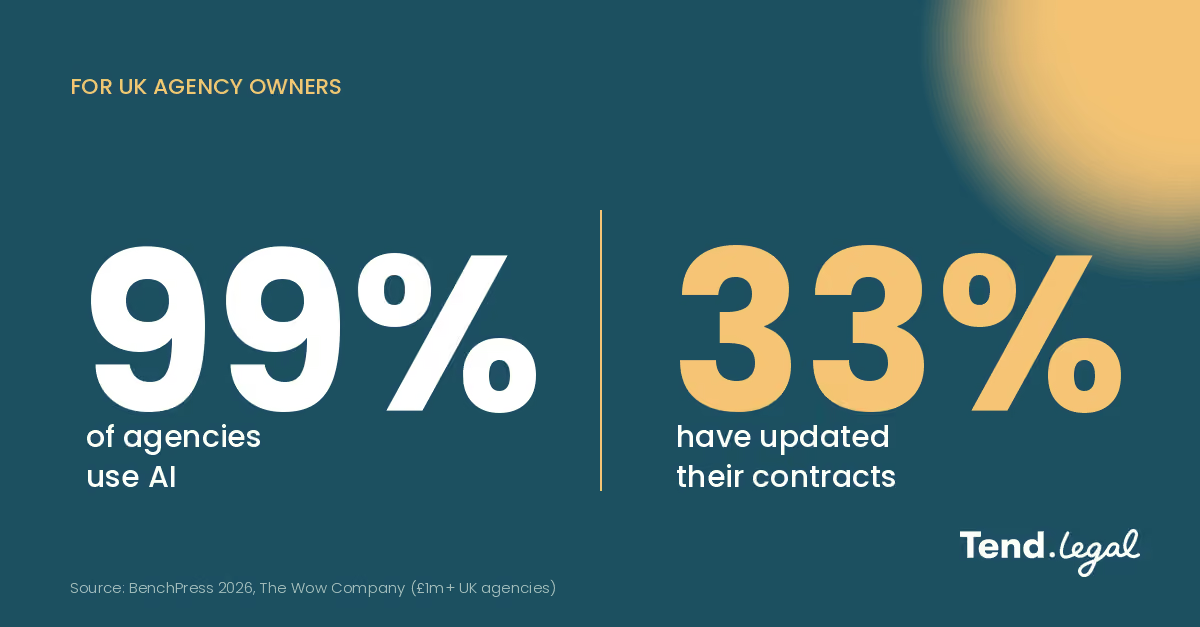
Almost every agency I speak to is using AI to deliver client work. Very few of them have updated their contracts to reflect it.
That's a problem. Not a dramatic, panic-stations problem, but the kind of quiet contractual drift that becomes expensive when something goes wrong. And if you're running a creative, marketing, digital or PR agency in 2026, it probably applies to you.
Recent BenchPress data (The Wow Company's survey of £1m+ UK agencies) shows 99% of agencies are using AI in some form. But only 33% have updated their terms and conditions to reflect that. Only 47% have told clients they're using AI at all. The gap between what's actually happening inside agencies and what their contracts say is wider than it's ever been.
This piece is about closing that gap. Specifically, the clauses in your master services agreement (MSA), terms of business, and statements of work (SOWs) that need attention now that AI is part of how you deliver.
What “AI clauses” in agency contracts actually means
An AI clause in an agency contract is any contractual provision that deals with how artificial intelligence is used to produce or support the services you deliver. That includes how you use AI internally, how you disclose it to clients, who owns what when AI is involved in creating a deliverable, who carries the risk if something goes wrong, and what happens to the data that flows through those tools.
Most standard agency contract templates, including many drafted by reputable firms five years ago, don't deal with any of this. They were written for a world where creative output came from humans using software as a tool. That's no longer the whole picture, and the commercial reality has moved faster than most contracts have.
Here's what actually needs updating.
1. Ownership of AI-generated work
This is the one that catches people out first. A typical agency MSA will include a clause assigning ownership of the deliverables to the client once the fees are paid. That clause was written on the assumption that your team wrote the copy, designed the asset, or built the site.
If significant parts of the deliverable were generated by AI, the legal position on who owns it is less tidy than most people realise. Under UK copyright law, purely AI-generated works are not straightforwardly protectable in the same way human-authored works are. The author needs to be identifiable. If nobody owns the output in the first place, assigning ownership of it to your client is effectively a promise you can't fully keep.
What good looks like: a clause that (a) is honest about how AI is being used in the delivery, (b) assigns whatever rights you do have in the output to the client, (c) gives the client a licence to use the output as intended, and (d) doesn't warrant that every element of the deliverable is protected by copyright when you don't know that it is. Belt and braces is useful. Silent overclaiming is not.
2. Liability and indemnities when AI gets it wrong
AI makes things up. It calls this “hallucination” because the word “lying” would be too on the nose. If your AI-assisted output contains a factual error, an infringing image, a quote that was never said, or a statistic that doesn't exist, and the client relies on it, you have a liability question.
Your existing indemnity clauses were written for human error in a human workflow. They may not sit neatly over AI-assisted output, and they may not cap your exposure in a way you'd want them to once AI is in the delivery chain.
What good looks like: explicit liability caps that are calibrated to the fees for the relevant project (not your total contract value), carve-outs where the client has reviewed and signed off AI-assisted material, and a realistic indemnity position that reflects how the work is actually being produced. Not everything that goes wrong should be your problem.
3. Disclosure and consent
Some clients are relaxed about AI in agency delivery. Some are explicitly contracting to avoid it. Some have their own internal policies they expect you to comply with. If your contract doesn't address disclosure, you're relying on conversations that may or may not have happened, which is not a great place to be if a dispute arises.
The BenchPress figure is telling here: 47% of agencies have told clients they're using AI, which means more than half haven't. That's either a lot of unspoken assumptions or a lot of unpleasant surprises waiting to happen.
What good looks like: a short, clear disclosure clause that confirms AI may be used in delivery, flags any specific tools or use cases the client should know about, and either (a) confirms the client consents or (b) gives them a mechanism to opt out or restrict use. This also gives you cover if the client has a change of heart six months in.
4. Data protection and client confidentiality
This is the one I'd worry about most. When you drop a client's brief, a transcript, a draft strategy, or a customer list into ChatGPT, Claude or Copilot, that data is leaving your systems and going into a third-party tool. Depending on the tool and the plan you're on, it may be processed, stored, used for training, or otherwise handled in ways that aren't obvious to your client.
If your contract has standard confidentiality and data protection clauses, they almost certainly don't address this directly. Your client's data protection team, if they have one, will want to know. If your client is in a regulated sector (financial services, healthcare, legal), they may have specific restrictions that make a quiet breach a big commercial problem.
What good looks like: an honest statement about what AI tools you use in delivery, confirmation that you've reviewed those tools' data handling practices, restrictions on what types of client data may or may not be processed by AI, and a mechanism for the client to specify constraints. The contract shouldn't be the first time they find out.
5. IP warranties and the training-data problem
Most agency contracts include an IP warranty: a promise that the deliverables don't infringe any third-party intellectual property rights. That was a reasonable promise to make when your team was creating the work from scratch.
It is a much harder promise to make when the tool you're using was trained on billions of pieces of third-party content, some of which the tool provider did not have permission to use. Whether AI outputs infringe the IP of the works they were trained on is a legal question that is, right now, actively being litigated. You don't want to be the test case.
What good looks like: an IP warranty that is honest about what you can and can't guarantee, ideally with a knowledge qualifier (“to the best of our knowledge”) and a carve-out for AI-generated elements where you've followed reasonable practice. This is a clause to get a lawyer to look at, not to fudge.
6. Subcontractor and freelancer flow-down
If you use freelancers or subcontractors, and they use AI (they do), everything above also applies to them. If your agency has promised the client you'll be careful with data or won't use certain tools, but your freelance copywriter is pasting the brief into whatever they've got open, you have a gap.
What good looks like: a clause in your freelancer and contractor agreements that flows down the AI obligations from your client contract. If you're telling the client you've got it covered, you need the people doing the work to be signed up to the same standards.
Getting this sorted without making it a project
You don't need to rewrite every contract you've ever signed. You do need to update your standard MSA, terms of business, and at least one of your SOW templates, and you need to think about what flows down to your contractors.
At Tend Legal we run a fixed-price AI contract review for agencies specifically designed for this. It's lawyer-led (we use AI tools in our own workflow but every update is reviewed by a qualified solicitor), priced at £1,250 + VAT for one MSA or terms of business plus one SOW, and we designed it for creative, marketing, digital and PR agencies. You can see the full service details and book a call here.
If you just want to stress-test what you've got, a 30-minute call with us is a sensible first move. If you know you need to fix it, the fixed-price AI contract update for agencies is the cleanest way to do it.
Frequently asked questions
Do I actually need to update my contracts if nothing has gone wrong yet?
You're updating them for the scenarios that haven't happened yet. The cost of a dispute, a regulator enquiry, or a client pulling the plug over an AI issue is much higher than the cost of getting the contracts right up front.
Isn't this just an IP issue?
No. It touches IP, liability, data protection, disclosure, and your flow-down to contractors. Treating it as only an IP problem is how you end up with a contract that solves one risk and ignores four.
Can I just add a single AI clause to my existing contract?
You can, but it usually isn't the right answer. The issues cut across several existing clauses (ownership, warranties, liability, confidentiality, data protection), so a single bolt-on tends to create conflicts with what's already there. A targeted review of the clauses that are actually affected is cleaner.
What if my client has their own AI policy and wants me to sign up to it?
Read it carefully before agreeing. Some client AI policies are reasonable; some are drafted on the assumption you're in a much larger organisation with more control over your AI stack than any agency realistically has. Push back where it matters.
Do I need to tell every client we use AI?
Pragmatically, yes. The risk of a client finding out some other way and feeling misled is worse than the risk of telling them upfront. Most clients are fine with it if they're told properly.
Is AI contract advice going to date quickly?
The underlying legal issues are moving, yes. The clauses we're recommending are drafted to handle the uncertainty rather than to bet on a specific legal outcome. That's the point. You want contracts that work whether the law settles one way or the other.
Alistair Wells is a commercial lawyer and the founder of Tend Legal, a UK law firm working with creative, marketing, digital and PR agencies. If you want to talk through how your contracts stack up against how you're actually using AI, book a call via the AI contract update service.
Obligatory lawyerly footnote: this article is written for information, not as legal advice. Reading it will not fix your contracts. For that, you need an actual lawyer looking at your actual contracts. Fortunately, we know where to find some.